Thursday, 8 October 2020

Lecture 5: The Mechanistic Hypothesis (Turvey, 2019, Lectures on Perception)

In the previous lecture, Turvey spent a lot of time defending the idea that nonlocal causality is a legitimate option for a physical system. He did this by looking at quantum mechanics and the extraordinarily robust evidence it has provided for nonlocality. The reason he did this is because perception as a two-term relation (direct perception) seems to require at least some nonlocal causality in order to work without additional terms (epistemic mediators). 

This chapter is a discussion of properties and how to organise them - ontology. Part of Turvey's work is to lay bare the fact a lot of our science is still working within the 17th century, mechanistic framework - all psychologists have encountered the idea that there are primary and secondary properties of things, and that we are in the business of understanding how the secondary ones work. But, as Turvey is describing, science has moved on, and the possible types of legitimately physical (primary) properties has expanded far beyond what Galileo, etc thought possible. For example, in quantum mechanics, particles don't have properties such as 'position' or 'velocity' until they are placed into a relation with either a position or a velocity measuring device. The property 'position' is impredicative, both defined and actualised by the presence of the relation to a position measurer. Historically, properties that are both defined and actualised by the property holder is in the relation have been considered to be secondary properties; subjective, not objective properties. But quantum mechanics considers particle position to be perfectly real, and it has the extraordinary level of empirical success required to back that claim up. 

This chapter walks the reader through the development of the mechanistic framework that still drives how we classify properties, thus affecting how we study them. It ends by identifying that this taxonomy begins to creak as we use it at the scale of behaviour, and points to the success of quantum physics to suggest a more expansive and interesting taxonomy of real properties is both required and an option. 

Tuesday, 9 June 2020

Lecture 4: Simulative, Projective, and Locality Assumptions (Turvey, 2019, Lectures on Perception)

This lecture is a brief history of the common assumptions made in theories of perception about how things 'over there' can cause us to have a given perceptual experience. The simulative and projective elements can be quickly dealt with; the big claim in this lecture is that the right notion of causation for perception is non-local, as it is in quantum mechanics. (Note: Turvey is not saying perception is a quantum process. He's just going to use it as a framing to explain what non-local causation is, and he will rely on the rigorous empirical testing it has passed in physics to say it is a viable notion of causation for a physical system.)

Wednesday, 29 April 2020

Lecture 3: Direct Perceiving, Indirect Perceiving (Turvey, 2019, Lectures on Perception)

In this lecture, Turvey provides a formal definition of what it means to claim a theory of perception is direct vs indirect. A theory of direct perception invokes lawfully specifying information, while all indirect theories invoke at least one mediating physiological or psychological process. Direct theories are allowed to discuss internal states, etc (Gibsonian neuroscience isn't a contradiction in terms), but these states are not allowed to alter information so it is no longer lawfully related to the environment. The big Turvey word we will learn about in this chapter is impredicative entailment - exciting! I'll also briefly point to some implications this chapter has for my recent papers with Sabrina on neuroscience and mechanism.

Friday, 24 April 2020

Lecture 2: Organism-Environment Dualism (Turvey, 2019, Lectures on Perception)

In this Lecture, Turvey lays out the organism-environment dualism that lies at the heart of pretty much all attempts to answer the question, how can an organism come to know about it's environment via perception? He discusses Descartes' mechanistic (mechanical) approach, and then pivots back to the idea that Composition, Environment, Structures (CES) systems are the only approach that can possibly cope with the nature of the problem. 

Wednesday, 15 April 2020

Lecture 1: What Kind of Systems Do We Study? (Turvey, 2019, Lectures on Perception)

The first thing to do is to characterise what it is we are studying when we are studying perception. Turvey states we are studying epistemic, intentional systems and spends this chapter explaining each term. He does the most work on system; intentional and epistemic are primarily just defined and noted as being features of the system we are going to have to engage with. 

As usual, I will try to efficiently review the key points and then add some reflections on what the chapter made me think about. 

Reading Group: Turvey (2019), Lectures on Perception


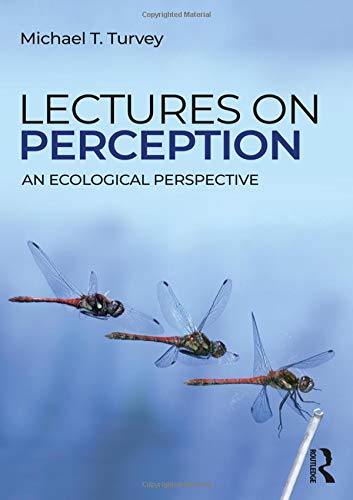
Michael Turvey ran a famously intense graduate level class on perception and action at CESPA. He has recently, finally, published a book of his lectures, in which he basically develops the ecological approach to perception-action from first principles. 

It's taken a while, but I have produced a series of posts, one lecture at a time. In each post, I attempted to (concisely) summarise the key points from the lecture. At the end, I reflected on what I've learned from the lecture, and connect it to issues in the literature. 

I would never have finished this if I hadn't been working with Rob Gray and Marianne Davis on the Perception-Action Podcast. I have linked to the Youtube video recordings and the audio podcast versions of our discussions below. 

Links to posts

  • Perception-Action Podcast episode on Lectures 1 & 2: Video  Podcast
  • Perception-Action Podcast episode on Lectures 3 & 4: Video  Podcast
  • Perception-Action Podcast episode on Lectures 5 & 6: Video  Podcast
  • Perception-Action Podcast episode on Lectures 7 & 8: Video  Podcast
  • Perception-Action Podcast episode on Lectures 9 & 10: Video  Podcast

Tuesday, 18 February 2020

Transfer of Learning a Novel Coordinated Rhythmic Movement

My PhD student Daniel Leach has just had his first paper accepted (preregistration, preprint, data & analysis files available here on the OSF) so it's way past time when I should blog this cool work. Danny and I have been developing methods, analyses and a theoretical framework to study learning and transfer of learning, and we have some interesting results (plus MANY more questions :) This post is about the first experiment just published; there's more to come!

We use coordinated rhythmic movement as our task; I've blogged this task in many posts and used this research programme as an example of theoretically driven, mechanistic modelling science. The basic form of the task is described here, the basic pattern of behavioural data is described here, and the model that implements our perception-action approach is described here. The main thing to know is that there are only a couple of rhythmic coordinations that are easy without training (0° and 180°), but other coordinations can be learned with feedback driven training. This gives us a simple model task that can serve as a window on perception-action mechanisms of skilled action and learning.